
last revised: 10.09.2026
Major points:
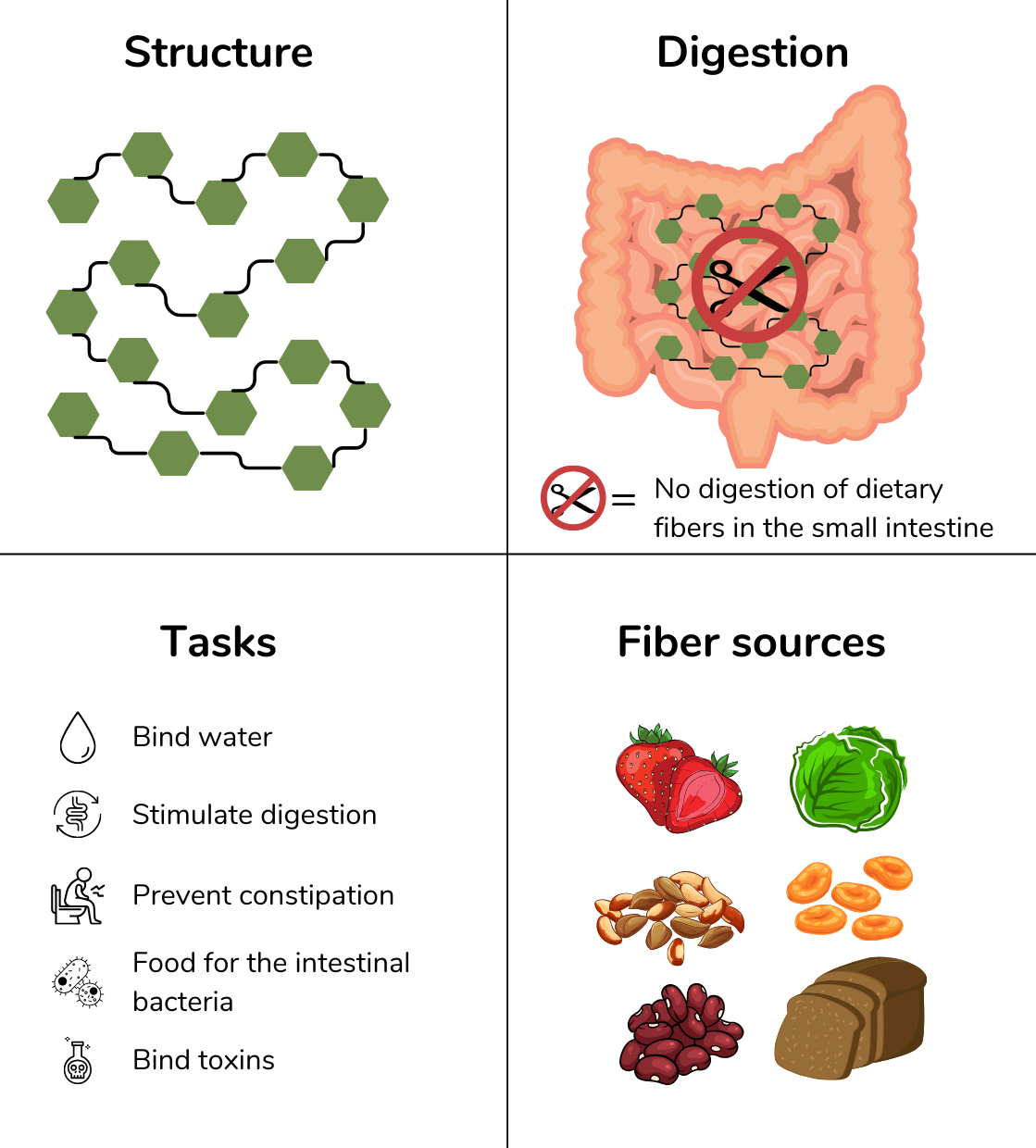
- Fiber cannot be broken down by the body’s digestive enzymes and is found almost exclusively in plant-based foods.
- Fiber contributes to longer satiety, prevents constipation, and binds toxins in the intestine.
- While Neatic does not focus on fiber, a fiber-rich diet can be beneficial due to its positive health effects.
What is fiber ?
Dietary fiber cannot be broken down by your body’s digestive enzymes.
It is found almost exclusively in plant foods such as:
- Grains (e.g., wheat, spelt, oats, and green spelt) and products made from them, such as bread and wholemeal pasta
- Legumes (e.g., lentils, chickpeas, and kidney beans)
- Nuts and seeds (e.g., walnuts, peanuts, linseeds, and pumpkin seeds)
- Fruits (e.g., apples, cherries, and raspberries, but also dried fruits)
- Vegetables (e.g., carrots, peppers, fennel, and cabbage)
Dietary fiber has different tasks
Fiber’s useful tasks include:
- It binds water, which makes the stomach contents more voluminous and thus increases satiety
- It stimulates digestion
- It prevents constipation
- It serves as food for good intestinal bacteria
- It binds toxins in the intestine
Which types of fiber exist?
A common classification distinguishes between insoluble and soluble dietary fiber based on its solubility in water. Insoluble fibers do not dissolve in water and include cellulose, some hemicelluloses, and lignin. They are abundant in whole grains, the skins of fruits and vegetables, as well as in nuts and seeds. In contrast, soluble fibers dissolve or swell in water and include pectins, β-glucans, gums, mucilages, and some hemicelluloses. They are naturally found in oats, barley, fruits, vegetables, and legumes.
Dietary fibers also differ in viscosity, water-holding capacity, and fermentability by the gut microbiota.
How much fiber do you need?
According to the German Nutrition Society (DGE), adults aged 19 years and older should consume at least 30 g of dietary fiber per day.
This target is difficult to achieve in a typical Western diet because dietary fiber is absent from animal-derived foods. Approximately 10 g of dietary fiber are provided by:
- 125 g wholemeal bread (about 3 medium slices)
- 200 g cooked wholemeal pasta (a small to medium portion)
- 105 g oats (about 10 tablespoons)
- 500 g apples (about 4 medium apples)
- 500 g strawberries (one large punnet)
- 320 g cooked carrots (about 4 medium carrots)
- 715 g tomatoes (about 6 medium tomatoes)
- 215 g cooked lentils (about 1 heaped cup)
- 110 g cooked kidney beans (about two-thirds of a cup)
- 125 g roasted peanuts (about 4 handfuls)
- 210 g walnuts (about 7 handfuls)
Consistent with these values, the German National Nutrition Survey II (2008) found that average dietary fiber intake was substantially below the recommended level, amounting to only 18 g per day in women and 19 g per day in men.
Proponents of fiber maxing often use this observation to justify adding isolated fiber to the diet. Further information about fiber maxing can be found here.
Tips for increasing your fiber intake
Here are four practical tips to improve your fiber intake:
- Choose fiber-rich alternatives
Replace fiber-poor foods with fiber-rich alternatives, such as wholemeal bread instead of white bread, wholemeal pasta instead of regular pasta, or oats instead of cornflakes. - Include legumes regulary
Try to include legumes such as lentils, beans, peas, and chickpeas in your diet on a regular basis. - Eat a variety of fruits and vegetables
Make the most of the wide variety of fruit and vegetables available and try to include different types in your diet. - Add nuts and seeds to your daily diet
For example, add a handful of nuts to your breakfast or sprinkle nuts and seeds over salads, yogurt, or porridge.
Putting these tips into practice: An example meal plan
- Breakfast: 50 g oats with 100 g raspberries and 5 g flaxseeds
- Lunch: 200 g cooked wholemeal pasta with 150 g zucchini and 40 g red lentils
- Snack: 1 apple and a handful of walnuts (30 g)
- Dinner: About two slices of wholemeal bread with cheese
This example meal plan provides approximately 40 g of fiber per day which is even more than the DGE recommends for adults.
What do you have to pay attention to?
If you eat fiber-rich foods, you should drink enough so that the fiber has sufficient liquid to swell, especially if you add wheat bran and psyllium husks to your meals. If you want to add more fiber to your diet, increase your intake slowly. Your gastrointestinal tract needs to get used to it. In the beginning, you may experience bloating or a feeling of fullness. This usually subsides after a while.
What does Neatic recommend concerning fiber?
Without a doubt, a high-fiber diet has health-promoting effects. Yet Neatic does not address fiber. Why? Because Neatic focuses only on added flavors, sweeteners, and sugar. Implementing Neatic’s principles is challenging enough. Adding more principles – on fiber, for example – would complicate the program and increase the risk of dropout.
There is nothing at all wrong with eating more fiber. You may even do this unconsciously with Neatic because you eat more fruit to satisfy your craving for sweets.
Bibliography
Deutsche Gesellschaft für Ernährung e. V. (2021): Ballaststoffe. Available online at https://www.dge.de/wissenschaft/referenzwerte/ballaststoffe/, checked on 9/8/2026.
Höfler, Elisabeth; Sprengart, Petra (2018): Praktische Diätetik. Grundlagen, Ziele und Umsetzung der Ernährungstherapie. 2., überarbeitete und erweiterte Auflage. Stuttgart: WVG, Wissenschaftliche Verlagsgesellschaft.