
last revised: 10.09.2026
Major points:
- Protein belongs to the macronutrients and is classified according to animal or plant origin.
- Protein provides energy and structure to body tissues, transports oxygen in the blood, enables muscle contraction and immune response, and forms the basis of numerous hormones and enzymes.
- Neatic does not limit the quantity or selection of protein.
What is protein and what functions does it have?
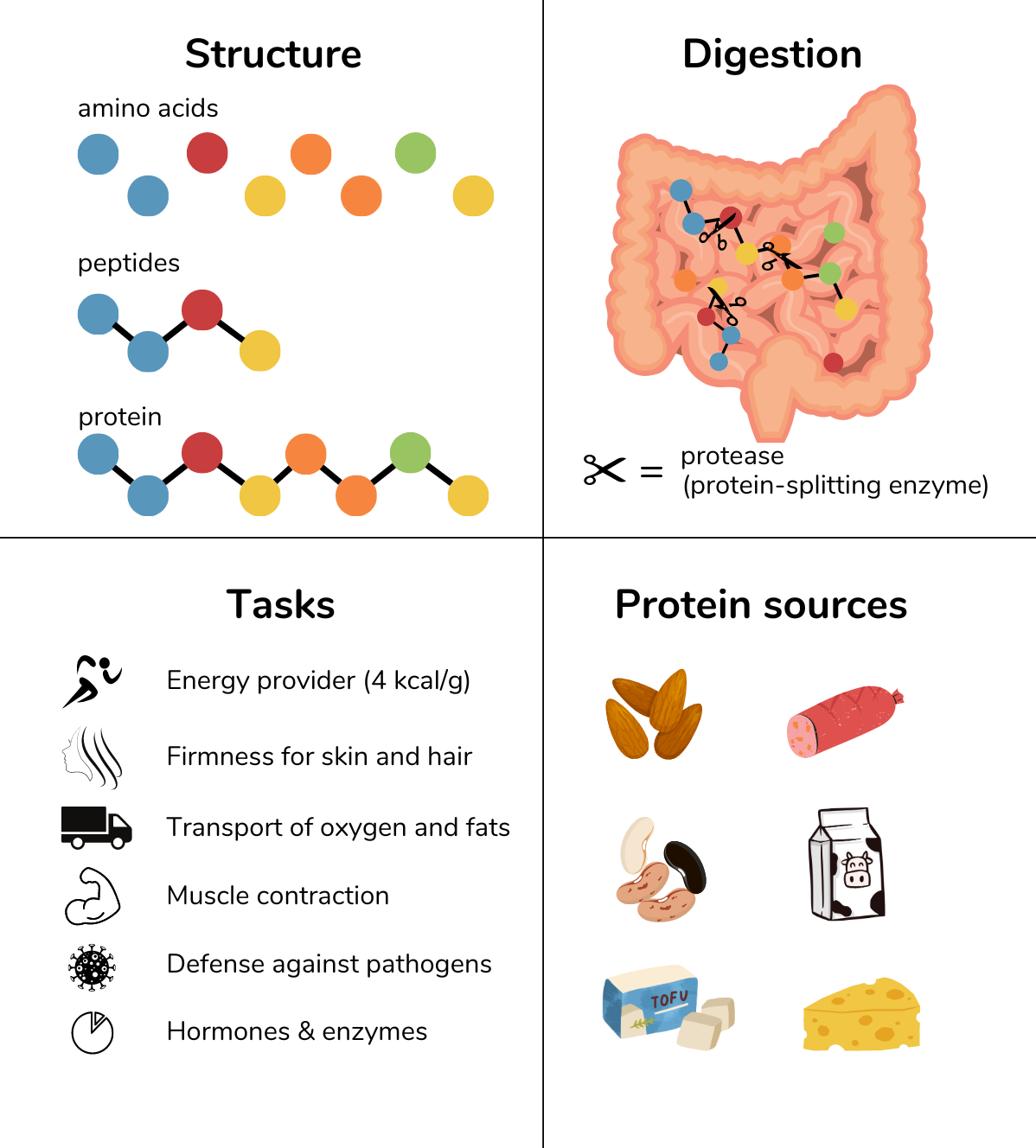
Protein is found in every cell in the body. Protein consists of many individual building blocks called amino acids. Amino acids are always linked together in the same way. Chains of up to 100 amino acids are called peptides, longer chains are called proteins.
The human body can use 20 different amino acids to build protein. Of the 20 amino acids, nine are essential. This means that the body cannot produce these nine amino acids itself. Therefore, they must be ingested through food. The other eleven amino acids can be built by the body of a healthy person.
Protein is found in many different foods
- Animal foods (e.g. eggs, meat, fish, milk, and cheese)
- Plant foods (e.g. tofu, nuts, beans, lentils, and peas)
Protein digestion begins in the stomach. There, proteins are denatured so that they can be broken down into individual amino acids by proteases (enzymes) in the small intestine.
Protein performs many different functions in the body:
- it provides energy (4 kcal/g)
- as collagen it gives skin and hair firmness
- as hemoglobin and lipoproteins it transports oxygen and fats in the blood
- as myosin it is an important component of muscle movement
- as antibodies it fights pathogens in the body
- as a hormone (e.g. insulin and glucagon) it regulates important body functions
- as an enzyme (e.g. lactase and lipase) it digests food components
How much protein do you need?
According to the German Nutrition Society (DGE), adults aged 19 and older should consume 0.8 g of protein per kilogram of body weight daily. For instance, an 80 kg (176 lb) adult male needs 64 g of protein per day (80 kg x 0.8 g/kg = 64 g).
This target is generally easy to achieve because many foods in a typical Western diet provide ample protein. Animal-based products like meat, fish, eggs, cheese, yogurt, and curd are especially rich in protein. Here is an example of how to meet this daily requirement:
- 150 g of chicken breast (35 g protein) – as an vegetarian alternative, 80 g red lentils (20 g protein) and 100 g tofu (15 g) would provide the same amount of protein
- 100 g of curd (13 g protein)
- 2 slices of whole-grain bread (6 g protein)
- 1 slice of Emmental cheese (10 g protein)
These four items alone provide the 64 g of protein needed by an 80 kg individual.
The National Consumption Survey II (2008) revealed that protein intake in Germany often exceeds the recommended amount for both men and women. Very few individuals fall below the suggested intake.
What is the biological value (BV)?
The biological value (BV) is a measure of protein quality. It assesses how well dietary protein can be converted into body protein. BV is particularly influenced by essential amino acids, which the body cannot produce on its own. The “limiting amino acid” is the essential amino acid present in the lowest quantity relative to body protein.
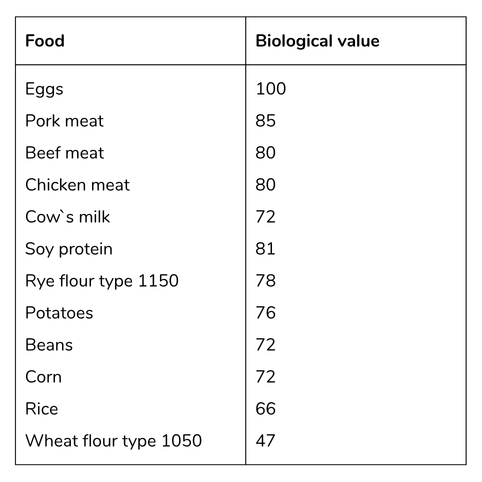
A higher BV means the protein source provides essential amino acids in the proportions needed by the body, making it more efficient for building body protein. Proteins that closely resemble the amino acid composition of body protein have a higher BV. For this reason, animal-based proteins often have higher BV than plant-based proteins. Chicken eggs, with a BV of 100, serve as the standard reference because they were once considered the best dietary protein source.
BV of common foods
The table below highlights the BV of various foods, demonstrating that animal-based proteins generally have higher values compared to plant-based sources:
Combining certain protein sources can yield a BV higher than 100, allowing the body to create protein even more efficiently. This is especially important for vegetarians and vegans.
Here are some effective food combinations:
- Potatoes + Eggs: For example, fried potatoes and fried eggs.
- Milk + Grains: Think cheese sandwiches or cereal with milk.
- Milk + Wheat Flour + Eggs: Pancakes or crepes are great options.
- Milk + Potatoes: Creamy mashed potatoes work perfectly.
- Legumes + Meat: Lentil stew with sausage.
- Legumes + Corn: A vegetarian chili sin carne.
What happens if you do not get enough protein?
If too little protein is supplied through the diet, the body has to respond. It does so by breaking down its own proteins, primarily from skeletal muscle. As a result, muscle mass decreases. For a bodybuilder, this may not be an immediate problem because there is a larger reserve of muscle mass available. The situation is different for older adults or people with illness. As muscle mass continues to decline, the risk of frailty and bone fractures increases. If protein deficiency persists for a prolonged period, the body can eventually no longer maintain normal metabolism and organ function.
Since the average protein consumption in Germany is above the recommended intake, protein deficiency is unlikely – even for vegetarians and vegans.
What does Neatic recommend concerning protein?
Neatic does not limit the amount or choice of protein. However, be cautious with processed foods since they may contain flavors, sweeteners, and sugar. Examples include marinated meats, various types of sausages, cheese preparations with herbs or spices, as well as plant-based meat and cheese products.
Recently, protein maxing has been promoted as a way to increase muscle mass and improve body weight. Everything you need to know about this trend can be found here.
Bibliography
Deutsche Gesellschaft für Ernährung e.V. (2021): Ausgewählte Fragen und Antworten zu Protein und unentbehrlichen Aminosäuren. Available online at https://www.dge.de/wissenschaft/weitere-publikationen/faqs/protein/?L=0, checked on 2/10/2022.
Elmadfa, Ibrahim; Muskat, Erich; Fritzsche, Doris; Meyer, Alexa Leonie (2019): Nährwert-Kalorien-Tabelle, Die große GU. Neuausgabe 2020/21. München: GRÄFE UND UNZER Verlag GmbH.
Höfler, Elisabeth; Sprengart, Petra (2018): Praktische Diätetik. Grundlagen, Ziele und Umsetzung der Ernährungstherapie. 2., überarbeitete und erweiterte Auflage. Stuttgart: WVG, Wissenschaftliche Verlagsgesellschaft.
Leitzmann, Claus; Keller, Markus (2020): Vegetarische und vegane Ernährung. 4., vollständig überarbeitete und erweiterte Auflage. Stuttgart: Verlag Eugen Ulmer.
Max Rubner-Institut (2008): Nationale Verzehrsstudie II. Ergebnisbericht, Teil 2. Die bundesweite Befragung zur Ernährung von Jugendlichen und Erwachsenen. Available online at https://www.bmel.de/SharedDocs/Downloads/DE/_Ernaehrung/NVS_ErgebnisberichtTeil2.pdf;jsessionid=9D48DD3B81AA52123DD134242DF6DC3A.live922?__blob=publicationFile&v=2, checked on 6/01/2021.