
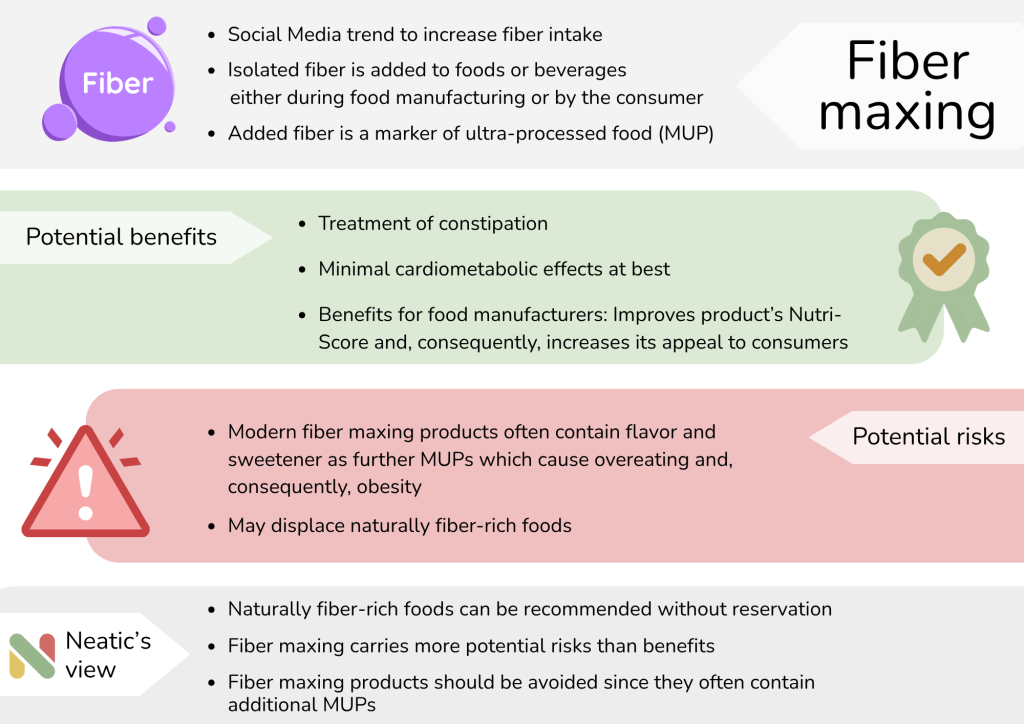
Major points:
- Fiber maxing, also referred to as fibermaxing or fibermaxxing, is a trend promoted primarily on social media that encourages the addition of isolated fiber products to the habitual diet.
- Added fiber is a marker of ultra-processed food (MUP) and many products containing added fiber, such as beverages and bars, also contain additional MUPs including added flavor, sweetener, and coloring agent.
- While naturally fiber-rich foods are associated with various health benefits, fiber maxing does not improve overall diet quality and may even have adverse effects, particularly when practiced through products containing additional MUPs.
What is fiber and what are its health benefits?
Detailed information about natural dietary fiber is available here. In brief, dietary fiber cannot be broken down by the body’s digestive enzymes and is found almost exclusively in plant foods such as whole grains, fruits, vegetables, legumes, nuts, and seeds. Dietary fiber has several important physiological functions. It binds water, promotes satiety, prevents constipation, serves as food for good intestinal bacteria, and binds toxins in the intestine.
What is the difference between increasing fiber intake naturally and fiber maxing?
Fiber intake can be increased naturally by consuming more fiber-rich whole foods such as whole grains, fruits, vegetables, legumes, nuts, and seeds. In most cases, this also improves overall diet quality, not least because it typically displaces ultra-processed foods (UPF).
In contrast, fiber maxing is a shortcut to increase fiber intake by adding isolated fiber to foods or beverages, either during food manufacturing or by the consumer. In this approach, fiber is typically added to foods and beverages that naturally contain little or no fiber. For example, several artificially sweetened beverages with added soluble fiber have recently been introduced and are marketed as healthy food choices.
Benefits of fiber-rich whole foods
There is convincing evidence that high consumption of fiber-rich whole foods is linked to increased life expectancy, decreased risk for myocardial infarction, stroke, type 2 diabetes mellitus, and colorectal cancer, as well as lower body weight, systolic blood pressure, and total cholesterol levels.
What are the potential benefits of fiber maxing?
Treatment of constipation
For fiber maxing, the strongest evidence supports its use in the treatment of constipation. In particular, psyllium (ispaghula husk), a soluble, gel-forming fiber, is recommended for this indication.
Minimal or no cardiometabolic effects
In contrast, the evidence supporting other clinically relevant health benefits of fiber maxing is not convincing. In a well-conducted 2-year intervention study involving healthy participants, supplementation with insoluble cereal fiber had no significant effect on glucose metabolism. These findings are consistent with those of a 3-month crossover trial in patients with type 2 diabetes mellitus in which supplementation with insoluble cereal fiber did not improve glycemic control. A meta-analysis of 83 studies found that soluble fiber supplementation significantly reduced systolic blood pressure by 1.4 mmHg and diastolic blood pressure by 0.7 mmHg. However, the authors acknowledged that this “level of systolic and diastolic blood pressure reduction found in our study might not be clinically important”. Similarly, a meta-analysis of 38 studies reported significant but small reductions in triglycerides (17 mg/dL) and low-density lipoprotein cholesterol (11 mg/dL) following soluble fiber supplementation. Concerning cardiovascular disease, a systematic review emphasized the need “for longer term, well-conducted randomized controlled trials to determine the effects of fiber type (soluble versus insoluble) and administration (supplements versus foods)”.
Two additional points should be considered when evaluating the potential benefits of fiber maxing. First, many intervention studies are funded by manufacturers of fiber maxing products and industry-sponsored nutrition studies are more likely to report conclusions favorable to the sponsor than independently funded studies. Second, social media campaigns promoting fiber maxing frequently cite studies on increasing fiber intake through naturally fiber-rich foods. However, these represent fundamentally different approaches. Unlike fiber maxing products which typically contain one or a few active ingredients, whole foods such as apples contain several thousand phytochemicals in addition to macronutrients, vitamins, minerals, and dietary fiber all of which may interact synergistically to provide health benefits.
Better Nutri-Score
Fiber maxing also offers benefits for food manufacturers: Because fiber is considered a favorable nutrient in the Nutri-Score, adding isolated fiber can improve a product’s Nutri-Score and, consequently, increase its appeal to consumers.
What are the potential risks of fiber maxing?
Ultra-processed food matrix
According to the NOVA classification, added fiber is a marker of ultra-processed food (MUP). Therefore, by definition, every fiber maxing product is an ultra-processed food item. However, there is no convincing evidence that added fiber per se has adverse health effects.
Rather, the food matrix to which fiber is added is of greater concern. Modern fiber maxing products typically incorporate isolated fiber into an ultra-processed food matrix. For example, soluble fiber is increasingly added to artificially sweetened beverages which also contain the MUPs flavor and sweetener both of which cause overeating and obesity. Therefore, the claim that an artificially sweetened beverage becomes a healthy choice simply by adding soluble fiber should be regarded as a marketing message not an evidence-based conclusion.
Displacement of naturally fiber-rich foods
Another potential concern is that fiber maxing products may displace naturally fiber-rich foods from the diet. After consuming three cans of a fiber-enriched artificially sweetened beverage containing 10 g of fiber each, consumers may assume that they have reached the daily recommended intake of 30 g of fiber established by the German Nutrition Society (DGE) and therefore forgo whole-grain products, fruits, and vegetables. However, fiber maxing and increasing the consumption of naturally fiber-rich foods are fundamentally different approaches with respect to their health-promoting potential.
What does Neatic recommend concerning fiber maxing?
Fiber maxing carries more potential risks than benefits. The use of the fiber psyllium for the treatment of constipation is well supported by the literature. However, because fiber maxing products often contain additional MUPs such as added flavor and sweetener, they should be avoided. In contrast, increasing the intake of naturally fiber-rich foods including whole grains, fruits, vegetables, legumes, nuts, and seeds has consistent health-promoting effects and can be recommended without reservation.
You can find out more about fiber here.
Bibliography
Chang, Lin; Chey, William D.; Imdad, Aamer; Almario, Christopher V.; Bharucha, Adil E.; Diem, Susan; Greer, Katarina B.; Hanson, Brian; Harris, Lucinda A.; Ko, Cynthia; Murad, M. Hassan; Patel, Amit; Shah, Eric D.; Lembo, Anthony J.; Sultan, Shahnaz (2023): American Gastroenterological Association-American College of Gastroenterology Clinical Practice Guideline: Pharmacological Management of Chronic Idiopathic Constipation. Gastroenterology 164 (7), pp. 1086–1106. DOI: 10.1053/j.gastro.2023.03.214.
Chartres, Nicholas; Fabbri, Alice; Bero, Lisa A. (2016): Association of Industry Sponsorship With Outcomes of Nutrition Studies: A Systematic Review and Meta-analysis. JAMA internal medicine 176 (12), pp. 1769–1777. DOI: 10.1001/jamainternmed.2016.6721.
Deutsche Gesellschaft für Ernährung e. V. (2021): Ballaststoffe. Available online at https://www.dge.de/wissenschaft/referenzwerte/ballaststoffe/, checked on 9/8/2026.
Ghavami, Abed; Banpouri, Sara; Ziaei, Rahele; Talebi, Sepide; Vajdi, Mahdi; Nattagh-Eshtivani, Elyas; Barghchi, Hanieh; Mohammadi, Hamed; Askari, Gholamreza (2023): Effect of soluble fiber on blood pressure in adults: a systematic review and dose-response meta-analysis of randomized controlled trials. Nutrition journal 22 (1), p. 51. DOI: 10.1186/s12937-023-00879-0.
Gupta, Jitendra; Abosaoda, Munthar Kadhim; Shukla, Madhu; Ballal, Suhas; Kumar, Abhishek; Chahar, Mamata; Saini, Suman; Kapila, Ish; Hadpoori, Alireza (2025): Effect of soluble fiber supplementation on lipid parameters in subjects with type 2 diabetes: A systematic review and meta-analysis of randomized controlled trials. Prostaglandins & other lipid mediators 176, p. 106939. DOI: 10.1016/j.prostaglandins.2024.106939.
Hartley, Louise; May, Michael D.; Loveman, Emma; Colquitt, Jill L.; Rees, Karen (2016): Dietary fibre for the primary prevention of cardiovascular disease. The Cochrane database of systematic reviews 2016 (1), CD011472. DOI: 10.1002/14651858.CD011472.pub2.
Honsek, Caroline; Kabisch, Stefan; Kemper, Margrit; Gerbracht, Christiana; Arafat, Ayman M.; Birkenfeld, Andreas L.; Dambeck, Ulrike; Osterhoff, Martin A.; Weickert, Martin O.; Pfeiffer, Andreas F. H. (2018): Fibre supplementation for the prevention of type 2 diabetes and improvement of glucose metabolism: the randomised controlled Optimal Fibre Trial (OptiFiT). Diabetologia 61 (6), pp. 1295–1305. DOI: 10.1007/s00125-018-4582-6.
Hyson, Dianne A. (2011): A comprehensive review of apples and apple components and their relationship to human health. Advances in nutrition (Bethesda, Md.) 2 (5), pp. 408–420. DOI: 10.3945/an.111.000513.
Jenkins, David J. A.; Kendall, Cyril W. C.; Augustin, Livia S. A.; Martini, Margaret C.; Axelsen, Mette; Faulkner, Dorothea; Vidgen, Edward; Parker, Tina; Lau, Herb; Connelly, Philip W.; Teitel, Jerome; Singer, William; Vandenbroucke, Arthur C.; Leiter, Lawrence A.; Josse, Robert G. (2002): Effect of wheat bran on glycemic control and risk factors for cardiovascular disease in type 2 diabetes. Diabetes care 25 (9), pp. 1522–1528. DOI: 10.2337/diacare.25.9.1522.
Reynolds, Andrew; Mann, Jim; Cummings, John; Winter, Nicola; Mete, Evelyn; Te Morenga, Lisa (2019): Carbohydrate quality and human health: a series of systematic reviews and meta-analyses. Lancet (London, England) 393 (10170), pp. 434–445. DOI: 10.1016/S0140-6736(18)31809-9.